
Stanford, California
Monday, November 2, 2026 · 12:30 PM – 1:20 PM
Add to calendarAbstract
Lithium-bearing brines offer the United States an opportunity to co-produce critical minerals and geothermal energy. Realizing this potential requires a better understanding of brine chemistry, reservoir dynamics, and the long-term sustainability of lithium extraction.
The Salton Sea geothermal field in California is a distinctive setting for lithium–geothermal co-production. Since 2004, geothermal brine production has averaged just over 120 million metric tons per year. At an estimated lithium concentration of 198 mg/L, this brine contains approximately 127,000 metric tons of lithium carbonate equivalent (LCE) annually. The estimated lithium inventory in the well-characterized portion of the field is 4.1 million metric tons LCE. However, estimates that account for geophysical data on reservoir extent and revised assumptions about porosity suggest that the broader Lithium Valley resource could contain as much as 18 million metric tons LCE (Kaspereit et al., 2016; Dobson et al., 2023). As direct lithium extraction advances, sustained production will depend in part on replenishment from deeper, convecting brines and lithium-bearing minerals in the surrounding reservoir. Fluid circulation and recharge, the chemistry and reactivity of deeper lithium-bearing minerals, and reinjection strategies may affect long-term recovery.
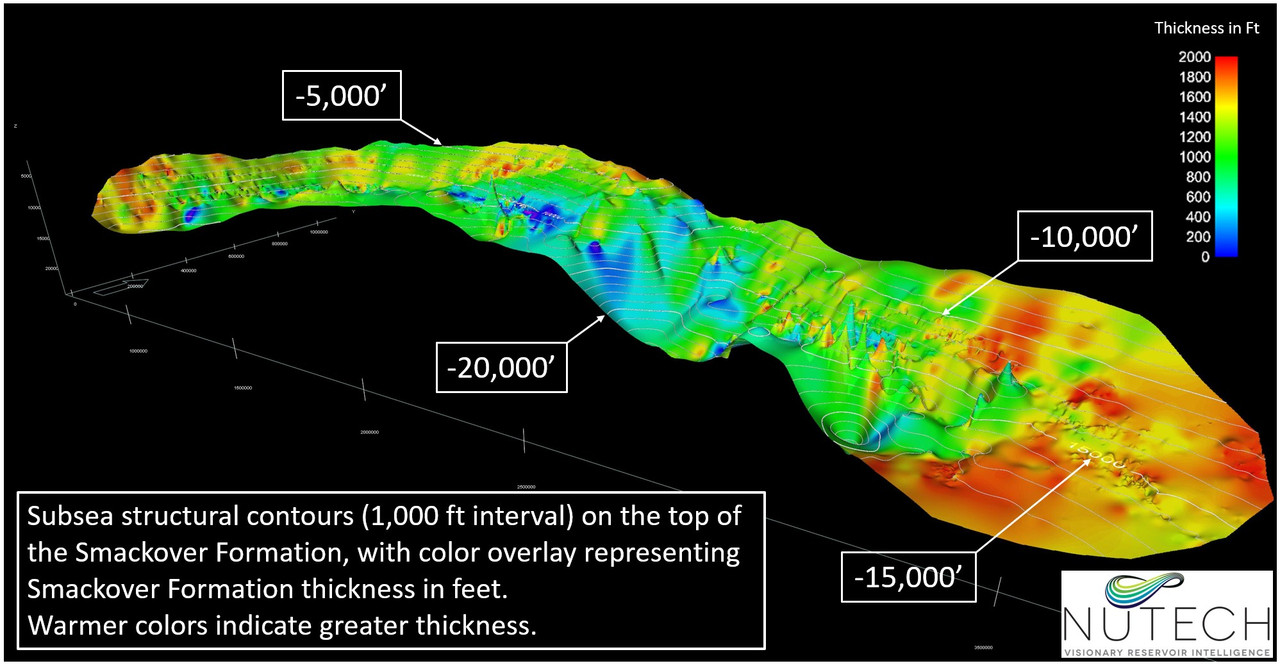
The Jurassic Smackover Formation, extending along the Gulf Coast from Texas to Florida, also contains some of the highest-lithium produced waters in the United States, with concentrations exceeding 500 mg/L in southern Arkansas. Concentrations in low-temperature thermal waters in Texas, Mississippi, and Alabama are generally lower but locally exceed 300 mg/L. Previous studies have associated Smackover lithium concentrations with H₂S levels, reservoir depth and thickness, water–rock interaction, and major faults. Our analysis of the U.S. Geological Survey’s National Produced Waters Geochemical Database supports an evaporitic origin for lithium and identifies substantial magnesium, which may need to be removed before lithium extraction. We are also investigating the role of clay minerals in the system. Together, these studies will inform extraction-process design and assessment of the potential to recover multiple critical elements, while improving understanding of the economic potential and long-term sustainability of domestic brine resources.
Bio
Eva Schill is a Staff Scientist in the Geophysics Department of Berkeley Lab’s Earth and Environmental Sciences Area (EESA) where she serves as the Lead of the Geothermal Systems Program of the Energy and Geoscience Division. At the Technical University of Darmstadt, Germany, Dr. Schill is Professor for Geophysics in Reservoir Systems. She obtained her Ph.D. from the Eberhard Karls University in Tübingen in Germany. After her postdoctoral research at ETH Zürich, Switzerland and Johannes Gutenberg University Mainz, Germany, where she was appointed first Junior Professor for Geothermics. After serving as Professor for Geothermics at the University of Neuchâtel, Switzerland, she was a leading scientist at the Karlsruhe Institute of Technology, Germany, before joining LBNL. Dr. Schil is a geologist and geophysicist and deals with geothermal issues from exploration to reservoir behavior. She combines various geological and geophysical methods to understand the structure of the subsurface. In combination with hydromechanical experiments, Dr. Schill is developing new monitoring methods that go beyond the monitoring of induced seismicity and shed light on reservoir processes. She is also working on new technologies to mitigate induced seismicity.
Research / Related Paper(s)
https://acrobat.adobe.com/id/urn:aaid:sc:US:8c6e759e-ed5f-4660-a342-d02062e6e92a
https://acrobat.adobe.com/id/urn:aaid:sc:US:708e3a4f-9ab5-4cd3-8393-8cc2786a10ff
Green Earth Sciences Building 367 Panama Street, Stanford, CA 94305 Room 104
Monday, November 2, 2026 · 12:30 PM – 1:20 PM
Green Earth Sciences Building · Room 104